
Introduction
The video game market, both in France and globally, has experienced strong growth in recent years, primarily due to the COVID-19 pandemic. After a sharp increase in revenue between 2020 and 2023, peaking at over 6.1 billion euros in 2023, the French market stabilized at around 5.7 billion euros in 2024.0F[1] By comparison, the video game market in France was valued at 2.8 billion euros in 2015,1F[2] meaning the market has doubled in size in less than a decade. At the same time, the recorded music market has undergone profound changes over the past decade, with the widespread adoption of music streaming platforms: tracks are abundant (more than 200 million tracks on Spotify2F[3]) and immediately available. This content on specialized platforms has complemented the music that has been available for the past twenty years on audiovisual platforms that also distribute music, such as YouTube and Dailymotion. It has since expanded to certain social media platforms where music plays a significant role, such as Instagram and TikTok.
In recent years, there has been a consolidation of “flow” listening practices of recorded music:3F[4] listeners are adopting contextual listening habits, which often take place at work or at home while doing household chores. This trend is coupled with the widespread availability on music platforms of “mood” playlists4F[5] (whether human-curated or algorithmically generated), in which soundtracks (films, TV series, video games, etc.) often play a significant role. Video game music, as soundtracks derived from video game works. Furthermore, some works are also part of more “active” listening patterns (outside of these “flows”), as evidenced by the recent success of the soundtrack to the French game Clair Obscur: Expedition 33, developed by Sandfall Interactive, both as recorded and live music. In 2025, the international video game music market was estimated at $1.4 billion and is projected to reach $3.2 billion by 2035.[6] These results show that music is becoming an increasingly important issue for video game developers and publishers, both as a promotional tool for their works and as a source of revenue diversification in an industry that is sometimes facing economic challenges.[7]
What is the market share of this specific sector in France? Which games and companies are performing the best? Which distribution strategies (platforms, social media, etc.) are best suited for which types of games? Finally, what are the major trends regarding live music (game types, production structures, concert venues)? To answer these questions, this exploratory study, analyzes a panel of more than 700 video games produced or published by at least one French company over the past three years. I identify each game–or not–on streaming platforms and track it over the same three-year period (international streams, revenue estimates; Box 1). Finally, certain distribution strategies on social media and live music strategies (Box 1) were observed over the same period, differentiated according to the game’s market segment.
| Box 1 – Streaming Data Collection[8] Sources. The analysis corpus includes video games released between 2023 and 2025, with at least one French development studio or publisher. The data was retrieved via IGDB[9] (Internet Game Database), a collaborative online database created in 2014 and acquired in 2019 by Twitch (a live broadcasting platform). The IGDB database lists not only games but also their developers, game genres, and associated platforms (console, PC, mobile). The presence of a game in the Spotify catalog was identified using the Spotify API (Application Programming Interface).[10] The presence of a game on YouTube was identified using the Google API.[11] Streaming data was retrieved via the Soundcharts API,[12] a data analytics and tracking service for recorded music. Presence on streaming services. On IGDB, 707 French games (excluding additional content) were identified. Each game title on this list was searched for using the Spotify API and the YouTube API. The search was refined using keywords such as “[game name] OST” or “[game name] Soundtrack.” On Spotify, 183 albums directly derived from the games were retrieved (representing 25.9% of the games initially identified). Additionally, 288 games were retrieved on YouTube (representing 40.7% of the games initially identified). Streaming data. On Soundcharts, 161 of the 183 albums identified on Spotify have their global streams tracked, for a total of 3,091 tracks. In 2023, 54 albums were released, compared to 57 in 2024 and 50 in 2025. Views for all 288 games identified on YouTube were retrieved via the YouTube API. Cumulative streams on Spotify were recorded as of December 31 of each observation year. On YouTube, views correspond to those of the top five videos found per game as of the data collection date of March 12, 2026 (after cleaning, the YouTube panel contains 903 videos). |
Macroeconomic Perspective: A growing Market despite disparities
Market size and growth
This study defines the French video game music market as tracks from games developed or published by at least one French company, observed between 2023 and 2025 (Box 1). Moreover, I only include original soundtracks, i.e., tracks or albums composed specifically for a video game and not previously released tracks used in licensing deals. These choices result in a rather broad field of study, as the video game industry is deeply integrated into the global economy, regularly involving collaborations or outsourcing between studios that are sometimes located far apart.[13] Similarly, certain French multinationals, such as Ubisoft, have subsidiaries or exclusive (“first-party”) studios in several countries.[14]
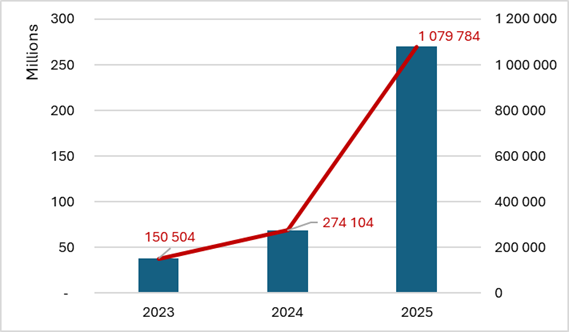
Between 2023 and 2025, the video games panel saw an increase in cumulative streams on Spotify (left-hand scale, Figure 1), rising from approximately 38 million streams in 2023, to approximately 270 million in 2025. The data shows an increase in the volume of streams between 2023 and 2024 by 82%, followed by an increase of nearly 300% between 2024 and 2025. This corresponds, on Spotify alone, to estimated revenue rising from 150,504 euros in 2023 to nearly 1.1 million euros in 2025[15] (right-hand scale, Figure 1). This observed increase is structural, as it corresponds to changes in the “stock” of tracks, with the panel size remaining constant between 2023 and 2025. Assuming a similar level of listening on other subscription-based streaming platforms, global consumption of music from French video games released between 2023 and 2025 would represent approximately 770 million streams in 2025,[16] generating over 3 million in revenue at Spotify’s average royalty rate.
In March 2026, the number of views for videos from the identified games panel (non-exhaustive, Box 1) on YouTube was 67.1 million.
Figure 1 – Total video game music streams on Spotify and estimated year-over-year (YOY) revenue
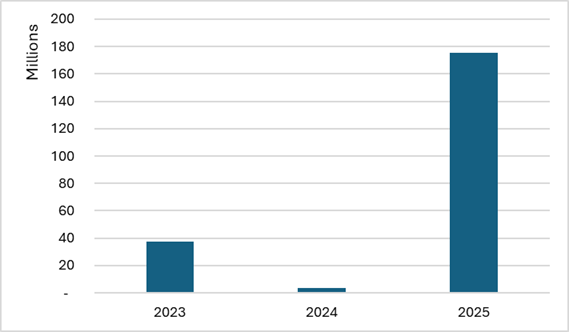
To refine the analysis, this examines the performance of games in terms of Spotify streams during their year of release (Figure 2). Thus, in December 2023, I examine the streams for games released in 2023; in December 2024, those for games released in 2024; and in December 2025, those for games released in 2025. This approach helps neutralize the “backlog” effect and allows us to observe whether the immediate performance of games on Spotify increases over the years of observation. Games released in 2023 generated 37.7 million streams on Spotify in 2023, compared to 3.8 million for games released in 2024 and 175.2 million for those released in 2025.
This large disparity between years (−89% between 2023 and 2024, +465% between 2023 and 2025) is not caused by a difference in the number of releases from year to year (Box 1). It can be explained by several factors, notably the huge success of the soundtrack for Clair Obscur: Expedition 33 (Sandfall Interactive) in 2025, as well as the postponement of several “AAA” games from 2024 to 2025, such as Assassin’s Creed Shadows (Ubisoft),[17] which are often the subject of more extensive promotional campaigns (see below).
Figure 2 – Spotify streams of video game music released in the same year
By way of comparison, the estimated number of streams worldwide on Spotify is 2,750 billion in 2025.[18] The sample of French video game music on Spotify in 2025 would therefore account for approximately 0.006% of the total global music market in 2025. While the upward trend (whether in “stock” or “flow”) observed in the French video game music market confirms its status as a fully-fledged segment of the recorded music industry, the following analysis of its distribution reveals a highly polarized structure.
A highly concentrated Market revealing inequalities
Despite the good performance in terms of views and streams on YouTube and Spotify, the video game music market is characterized by high concentration and various forms of inequality, primarily due to the size of the studios (developers or publishers). First, the structure itself of the video game panel is biased: only 183 of the 707 identified games were found on Spotify, and 288 on YouTube, corresponding respectively to 25.9% and 40.7% of the initial panel (Box 1). In other words, between three-quarters (on Spotify) and 40% (on YouTube) of French games are experiencing a loss of revenue resulting from the lack of monetization of their music through streaming. This creates two subsets: a “visible” sample of 183 games on Spotify, and a “non-visible” sample of 524 games on Spotify (Table 1).

This significant difference between visible and non-visible games stems primarily from a dichotomy between independent and major developers and publishers: the latter prioritize the visibility of their soundtracks on music platforms, while independents […] distribute their soundtracks less frequently on these platforms.
First, in terms of video game genres, the “non-visible” sample is characterized by genres such as arcade and simulation, genres that are often well-suited to independent development due to their scale or budget.[19] Conversely, the “visible” sample is dominated by genres suited to large-scale AAA productions (see below), such as adventure and role-playing games (RPGs). Ubisoft also holds a very dominant position (nearly 50% of the games) in the visible sample, reflecting an active distribution strategy by the major studios. In the non-visible sample, however, no single company holds a truly dominant position, indicating greater market segmentation resulting from the large number of independent developers and publishers in this subsample. This significant difference between visible and non-visible games stems primarily from a dichotomy between independent and major developers and publishers: the latter prioritize the visibility of their soundtracks on music platforms, while independents–due to a lack of resources or a well-thought-out music strategy–distribute their soundtracks less frequently on these platforms.
Table 1 – Top 5 genres, companies, and platforms by panel[20]
| Available Panel on Spotify | Non available Panel on Spotify | |||||
| Number of games | Share (%) | Number of games | Share (%) | |||
| Top 5 Genres | Top 5 Genres | |||||
| Adventure | 118 | 73,29 | Indie | 275 | 52,48 | |
| Indie | 102 | 63,35 | Adventure | 188 | 35,87 | |
| RPG | 51 | 31,67 | Simulation | 121 | 23,09 | |
| Strategy | 41 | 25,46 | Strategy | 120 | 22,91 | |
| Puzzle | 33 | 20,49 | Arcade | 84 | 16,03 | |
| Top 5 Companies | Top 5 Companies | |||||
| Ubisoft | 79 | 49,06 | Nacon | 43 | 8,21 | |
| Nacon | 13 | 8,07 | y-zo studio | 34 | 6,48 | |
| Focus Entertainment | 10 | 6,21 | Microids | 29 | 5,53 | |
| Microids | 8 | 4,97 | Ubisoft | 19 | 3,62 | |
| Plug in Digital | 7 | 4,35 | Focus Entertainment | 13 | 2,48 | |
| Top 5 Platforms | Top 5 Platforms | |||||
| PC | 161 | 100,00 | PC | 447 | 85,30 | |
| PlayStation 5 | 97 | 60,25 | PlayStation 5 | 155 | 29,58 | |
| Xbox Series | 87 | 54,04 | Xbox Series | 128 | 24,42 | |
| Nintendo Switch | 76 | 47,20 | Nintendo Switch | 122 | 23,28 | |
| PlayStation 4 | 62 | 38,51 | PlayStation 4 | 119 | 22,71 | |
In addition, we observe a high degree of market concentration among the visible tracks themselves. Over the entire period, 10% of the games accounted for 88.9% of streams on Spotify, reflecting very high levels of inequality. As we will see below (Table 2), almost all of the streams in the panel in 2025 (88.8%) concern the game Clair Obscur: Expedition 33 (Sandfall Interactive). Even after excluding this specific game, the top 10% of games over the entire period still account for 76.2% of streams, indicating a very high level of structural concentration around a few games. Regarding concentration by company, 10% of companies account for 96.5% of streams when including Clair Obscur: Expedition 33, or 93.9% when excluding it. I also track changes in this indicator over the years of observation to determine whether this concentration trend around certain games or studios is increasing or decreasing. As for the concentration of games, it follows the trend in plays observed previously (Figure 2): 10% of games accounted for 93% of plays in 2023; this indicator declined in 2024, when 10% of games accounted for 68.7% of plays, then began to rise again in 2025, when 10% of games accounted for 95.7% of streams.[21] The trend is more linear concerning the companies: 10% of companies accounted for 92.3% of the streams in 2023, 93.3% in 2024, and 96% in 2025.[22]
At the macroeconomic level, the French video game music market is therefore a growing market, though with fluctuations from year to year, partly due to its sensitivity to the overall state of the video game market. This market is characterized by a “superstar” economy,[23] where a few critical and commercial successes (notably AAA titles or major independent breakthroughs) account for nearly all streams. In the following sections of this study, I will examine the specific characteristics of this market by analyzing the performance of certain games and the strategies of their development and publishing studios.
This market is characterized by a “superstar” economy,[23] where a few critical and commercial successes (notably AAA titles or major independent breakthroughs) account for nearly all streams.
Microeconomic Perspective: A diversity of Models associated with different strategies
Typology of success stories: Actors, Genres, and Format
As mentioned in the previous section, this market is characterized by significant disparities among games: the average number of Spotify streams per game is 160,300 over the entire observation period, which corresponds to an estimated revenue of 641.2 euros. However, the Top 20 games in the panel (Table 2) performed well above this level in terms of both streams and revenue generated. In 2025, the average number of streams for the Top 20 was 12.6 million, with a peak of 155.7 million streams for the single game Clair Obscur: Expedition 33 alone (88.8% of the panel’s total streams in 2025). This average number of streams corresponds to average revenue by game of 50,436 euros. While this amount may seem modest for an AAA production–estimated to have a budget of several million dollars (see below)–it would represent significant additional revenue for some smaller studios, or even independent ones.
Table 2 – Top 20 games by Spotify streams in 2025
| Title | Spotify Streams | Spotify revenue (€) |
| Clair Obscur: Expedition 33 | 155 719 793 | 622 879,17 |
| Atomic Heart | 46 244 592 | 184 978,37 |
| Assassin’s Creed Mirage | 12 908 613 | 51 634,45 |
| Jusant | 5 362 806 | 21 451,22 |
| Assassin’s Creed Shadows | 3 743 274 | 14 973,10 |
| Lost Records: Bloom & Rage | 3 669 452 | 14 677,81 |
| The Last Spell | 3 278 624 | 13 114,50 |
| Avatar: Frontiers of Pandora | 2 960 654 | 11 842,62 |
| Windblown | 2 776 619 | 11 106,48 |
| Harmony: The Fall of Reverie | 1 819 884 | 7 279,54 |
| Blood Rush | 1 749 139 | 6 996,56 |
| Absolum | 1 685 660 | 6 742,64 |
| The Rogue Prince of Persia | 1 575 677 | 6 302,71 |
| The Crew: Motorfest | 1 572 607 | 6 290,43 |
| Endless Dungeon | 1 493 087 | 5 972,35 |
| Star Wars Outlaws | 1 428 931 | 5 715,72 |
| Prince of Persia: The Lost Crown | 1 016 103 | 4 064,41 |
| Drive Beyond Horizons | 920 656 | 3 682,62 |
| Fretless – The Wrath of Riffson | 793 454 | 3 173,82 |
| Chants of Sennaar | 766 725 | 3 066,90 |
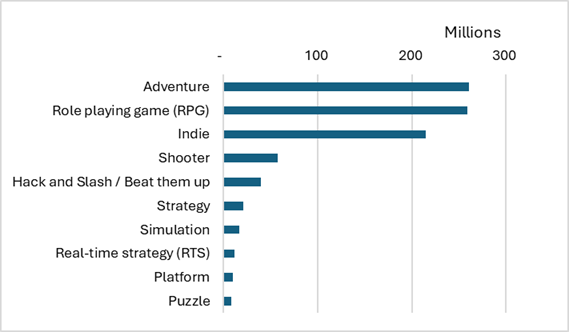
When analyzing the distribution of streams on Spotify by video game genre, several trends emerge (Figure 3). First, the top-performing genres in terms of streams are role-playing games (RPGs) and adventure games. These two genres, which often complement each other,[24] are also well-suited to AAA games,[25] most often open-world or semi-open-world, such as the Assassin’s Creed series or Star Wars Outlaws. The large scale of these games, combined with budgets that can reach several hundred million euros,[26] makes their soundtracks an element that can be planned early on, right from the development phase, as a source of promotion and revenue for studios. These genres are also represented in “AA” games, i.e., smaller-scale titles whose developers or publishers are often independent, but which can rival the biggest productions, such as Clair Obscur: Expedition 33.
We can observe another trend with the “indie” genre (Figure 3). While this genre says nothing about the gameplay[27] of the game to which it refers, it does express what that game is not: namely, a game developed and/or published by a major studio. In our panel, a large proportion of these games (102 out of 183) fall under the indie category. This “industrial” genre is associated with video game genres well-suited to independent development, such as platformers or “beat ’em up” games[28] (progression-based fighting games). Finally, simulation and puzzle genres occupy a more “niche” segment, split between indie games and AA titles, particularly sports simulation games with licensed properties such as Tour de France 2024 (Nacon).
Figure 3 – Top 10 genres by streams on Spotify
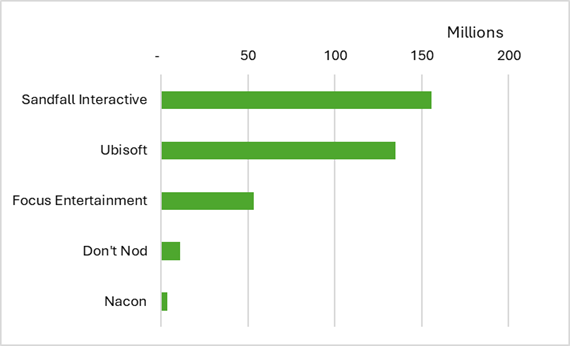
When looking at the five top-performing companies in the panel (Figure 4), we see the same kinds of trends. Sandfall Interactive embodies this AA segment, which in this specific case rivals or even surpasses major AAA productions, recording nearly 156 million of Spotify streams in 2025 (all attributed to the game Clair Obscur: Expedition 33). The publisher Focus Entertainment (now PulluP Entertainment) also represents this type of studio capable of developing or publishing AA games such as Atomic Heart and recorded over 53 million streams on Spotify in 2025. Furthermore, this publisher also falls within the simulation and puzzle genres identified earlier: smaller-budget games, such as the puzzle game Chants of Sennaar. The multinational Ubisoft recorded over 135 million Spotify streams in 2025; it is the leading representative of the AAA segment in this study’s game panel, with titles already mentioned–such as the Assassin’s Creed series–or major film-based franchises like Star Wars Outlaws and Avatar: Frontiers of Pandora. Finally, Don’t Nod Entertainment and Nacon round out this ranking, with 11 million and 4 million streams, respectively, in 2025. These studios develop and publish AA games such as Lost Records: Bloom & Rage (Don’t Nod), licensed simulation games such as Tour de France 2024 (Nacon), as well as smaller indie titles such as Jusant (Don’t Nod). These streaming figures do not depend solely on a game’s popularity (although they are largely linked to it) but also result from deliberate marketing strategies. The following section analyzes how three studios–each located at one of the identified tiers (AAA, AA, and indie)–promote and capitalize on their soundtracks.
Figure 4 – Top 5 companies by streams on Spotify
Promotion strategies: Analysis of three Case Studies
The following analysis focuses on the music-based marketing strategies of three games from the panel, each belonging to one of the following market segments: AAA, AA, or Indie. The comparison criteria are based on format (digital or physical release), the timing of the soundtrack’s release relative to the game’s release, their social media promotion strategies (particularly on Instagram, TikTok, and Twitch), and their transmedia strategies (partnerships, concerts, and licensing) (Table 3).
Table 3 – Strategies for Three Games
| Title | Company | Format | Release timing | Social Media Promotion | Transmedia |
| Assassin’s Creed Shadows | Ubisoft | Digital, Physical (Vinyl) | –7 days +7 month | Yes | Yes |
| Clair Obscur: Expedition 33 | Sandfall Interactive | Digital, Physical (Vinyl, CD) | +15 days +9 month | Yes | Yes |
| Chants of Sennaar | Rundisc, Focus Entertainment | Digital | +30 days | No | No |
Assassin’s Creed Shadows: A Standard Case Study of the “AAA” Strategy
The Assassin’s Creed franchise, launched in 2007 by Ubisoft, is today one of the world’s leading video game series and one of the main representatives of the AAA segment mentioned earlier. From a distribution strategy perspective, Ubisoft has opted for a cost-effective digital distribution on streaming platforms (Spotify, Deezer, Apple Music, YouTube, etc.),[29] as well as physical distribution on vinyl. This physical distribution is comparable to “premium” content, sold at a high price, with the aim of capitalizing on collectibles (similar to the merchandise sold during a concert tour, for example) to strengthen loyalty within the game’s community.[30] By the end of 2025, this game had 3.7 million streams on Spotify and nearly 1.2 million views on YouTube, ranking among the top five most popular titles in the overall panel (Table 2) less than a year after its release, demonstrating significant immediate success.
The timing of this soundtrack’s release is also significant. In addition to the use of tracks from the soundtrack in the game’s trailer, which was released in May 2024 (i.e., ten months before the game’s release on March 20, 2025), the tracks were made available digitally on March 14, 2025, across all platforms. This one-week early release reveals a well-thought-out marketing strategy designed to build anticipation within the game’s community, in which the game’s music plays a central role as a promotional tool. The physical release came out on October 17, 2025 (i.e., seven months after the game’s release) as a collector’s item. Similarly (though to a lesser extent), this delayed release can be compared to the release of additional game content (“downloadable content” or DLC)–that is, a way to capitalize once again on player engagement through optional content that promotes a sense of belonging to a community.
We also observe a promotional strategy on social media (Instagram, TikTok), as well as transmedia strategies (YouTube, Twitch). First, the Assassin’s Creed game series has dedicated social media accounts, with 1.6 million followers on Instagram and 700,000 on TikTok. When promoting the game, these accounts create content that highlights the unique features of Assassin’s Creed Shadows, as well as its music. However, the results suggest that the tracks are rarely used as reusable “sounds” by users to create content on TikTok or Instagram: most videos featuring the game and its soundtrack do not specify the exact title of the track used. In addition, the game collaborated with the famous French music channel “Lofi Girl”, which has 15.7 million subscribers on YouTube; the channel is Japanese-inspired (in line with the theme of Assassin’s Creed Shadows) and streams continuous background music. This collaboration led to the release–both digitally (on all platforms) and physically (on vinyl)–of tracks from the game remixed in a lo-fi style, ideal for contextual listening (see above). It had over one million views on YouTube as of February 2026. Finally, a promotional campaign took place on Twitch in the form of partnerships with major French streamers, such as Squeezie and ZeratoR.[31]
Finally, there is no concert tour dedicated specifically to this game. However, it is part of a series that is nearly twenty years old, which is the subject of regular tours and performances (such as at the Philharmonie de Paris in 2026).[32] The use of all these promotional channels reflects a marketing strategy typical of an AAA game, in which music plays a dual role: as a promotional tool (as seen in the trailer or on social media) and as a commercial product on its own (on streaming platforms, in physical format, or as part of collaborations).
Clair Obscur: Expedition 33: Redefining the Boundaries of AA Success
The game Clair Obscur: Expedition 33, developed by the French studio Sandfall Interactive, enjoyed tremendous success in 2025. It won the Game of the Year award at The Game Awards (the “Oscars” of the video game industry)[33] and, in late 2025, launched a concert tour in France and internationally. Although the game enjoyed widespread success, it falls on the fringe of AA games, with a budget lower than that of a AAA game, and relies primarily on its gameplay and artistic direction (in which music plays a very important role) to build its critical and commercial success. The teams at Sandfall Interactive (and the game’s UK publisher, Kepler Interactive) also released the game’s soundtrack across multiple formats: digital release on all platforms, as well as vinyl and CD. These latter two distribution formats follow the same logic mentioned earlier: namely premium collectibles designed to foster loyalty within the game’s community. By the end of 2025, the game had racked up 156 million streams on Spotify (ranking first in the panel, Table 2) and nearly 50 million views on YouTube.
Besides the trailer released on June 10, 2024 (ten months before the game’s official release on April 24, 2025) the digital release of the game’s soundtrack came out on May 9, 2025, about fifteen days after the game’s release. However, about ten tracks from the soundtrack were released before the game as promotional tools. This reflects a different approach to Ubisoft’s AAA strategy: a hybrid strategy in which music is not used purely as a promotional tool (even though part of it serves that purpose), but is also used as an extension of the gaming experience, with music playing a significant role.[34] Moreover, similar to Ubisoft, the physical release on CD and vinyl came out in February 2026 (nine months after the game’s release) in order to capitalize on its success over the long term.
The game’s social media strategy is similar to the one mentioned earlier: there are dedicated accounts on TikTok (32,000 followers) and Instagram (220,000 followers). These accounts make limited use of the tracks as “sounds” (i.e., as clips that other users on these platforms can directly reuse to create content). However, certain tracks from the soundtrack have enjoyed some success as “sounds,” such as “Lumière” (3,178 videos created on Instagram) and “Clair-Obscur” (over 12,000 videos on TikTok). Given the critical success of the game and its soundtrack, other transmedia initiatives have been launched, particularly on YouTube and Twitch, including various interviews with the musicians and composers of the game’s soundtrack on major channels within the French Twitch community,[35] as well as live-streamed concerts, notably during the “Z-Event” charity event.[36]
Finally, the most striking example of transmedia dynamics surrounding this video game is the European concert tour featuring tracks from the soundtrack, entitled A Painted Symphony, scheduled for March through May 2026. Given the significant success of the game’s soundtrack, the teams at Sandfall Interactive decided to launch a concert tour in France, followed by a European tour after the success of the French one. The strategy deployed for this game illustrates, more broadly, the positioning of AA productions: music is conceived both as a promotional tool and as an extension of the gaming experience. Once critical and commercial success is confirmed, the studio can implement initiatives typically associated with AAA productions, such as physical releases or concert tours.
While the AAA strategy uses music as a commercial and promotional tool, and the AA strategy uses it both as a commercial tool and as a status symbol, indie developers demonstrate that music can contribute to a game’s long-term sustainability.
Chants of Sennaar: A French Indie Game that Invites Contextual Listening
Chants of Sennaar is a French indie game developed by Rundisc and published by Focus Entertainment (now PulluP Entertainment). It falls into the third category identified in the previous section: that of indie games (puzzle games, in this specific case) with more modest budgets, whose music lends itself to a more contextual (mood-based) listening experience. First, the game’s soundtrack is available exclusively in digital format across all platforms. Physical distribution, which is more expensive, is an indicator of successful AAA or AA titles; games with more modest budgets (such as this one) rely on a soundtrack distributed digitally, which keeps distribution costs low. By the end of 2025, the game had 766,725 streams on Spotify (ranking 20th among the games in the panel) and over 150,000 views on YouTube.
First, we observe that the digital release on streaming platforms occurred after the game’s release (excluding the trailer, which was released in April 2022, i.e., nearly a year and a half before the game’s release in September 2023). Indeed, the game was made available on streaming platforms one month after its release, in October 2023. This release schedule may reflect a more “cautious” approach to resource management by an independent developer: releasing the game on schedule with stable software performance could be the priority for this type of studio. Furthermore, from a marketing perspective, this time lag could help generate a “second wave” of visibility–less distant in time than the physical releases discussed earlier, but still allowing the game to gain initial exposure before the music extends the experience after the game ends (since Chants of Sennaar is a fairly short game to complete, taking around ten hours).[37]
Unlike the two previous examples, there is no social media strategy centered on the game’s music: no Instagram or TikTok account dedicated to the game, and no use of the game’s tracks as “sounds” to facilitate community-driven content creation. Most of the social media communication surrounding the game focuses on its gameplay, which features linguistic puzzles and environmental riddles. Similarly, there is no specific transmedia strategy related to the game’s music, such as external partnerships or concerts. However, players were able to discover the game’s soundtrack through various “let’s plays” (video gameplay sessions/walkthroughs) available on YouTube and Twitch.
However, this relative lack of marketing strategy for the game’s music hasn’t prevented the public from embracing the soundtrack: as previously mentioned, the game ranks 20th out of 161 in our panel in terms of Spotify plays and has enjoyed significant success on YouTube. When we look specifically at how this soundtrack is used, we notice that it is typically listened to in context, to set a certain “mood”. Tracks from this soundtrack appear on community playlists on Spotify such as “Writing Focus” (11,399 saves) and “Chill Game Music” (6,821 saves). This use of tracks during passive listening is characteristic of music from “Chill Games”: most often indie games puzzle, or exploration games with few or no enemies. This listening pattern is conducive to “Long-Tail”[38] success–that is, a niche hit that generates steady revenue over time, as opposed to the immediate, widespread successes mentioned earlier. The game’s 20th-place ranking in the panel validates the effectiveness of this long-tail model over time.
In summary, while the AAA strategy uses music as a commercial and promotional tool, and the AA strategy uses it both as a commercial tool and as a status symbol, indie developers demonstrate that music can contribute to a game’s long-term sustainability. Without an active marketing strategy, music can become part of listening habits through users’ contextual use, facilitated by music platforms (Spotify, Deezer, etc.) as well as platforms more focused on audiovisual content (YouTube, Twitch).
Overview of Live Events: Games, Structures, and Venues
The video game music market is not limited to what has been discussed so far (i.e., recorded music). Video game music also generates consumption through live performances. As mentioned earlier, these live performances can serve as a strategy to strengthen the community or enhance prestige following major successes. It also serves as a source of additional revenue beyond direct game sales or even recorded music sales. In France, Japanese productions–such as the Final Fantasy series (Square Enix) and The Legend of Zelda series (Nintendo)–are the most prominent in the lineup of video game music concerts. Historically, this can be explained by the fact that live performances centered on video games originated in Japan in the late 1980s, with the goal of making so-called classical music more accessible through video games.[39] Generally speaking, it is primarily AAA franchises (both French and international) that are the focus of live performances (such as the Assassin’s Creed Symphonic Adventure tour), although certain AA franchises (due to critical or commercial success) are sometimes included as well.
The structure of this market is based on a hierarchy of players with varied business models, reflecting the AAA/AA/Indie segmentation seen in the recorded music industry. Among the “majors” in video game show production, companies such as Overlook Events and G1 Production (often associated with international tours) hold a dominant position. These players manage global licenses (including the Japanese game licenses mentioned earlier) and produce big-budget tours in France capable of filling large-capacity venues. For example, the “Distant Worlds: Music from Final Fantasy” and “Elden Ring Symphonic Adventure” tours (Overlook Events) have performed in major Parisian venues, such as the Palais des Congrès (capacity: 3,700 seats), or large regional venues like the Zénith in Toulouse (capacity: 11,000 seats). There are also smaller, independent acts, such as the Neko Light Orchestra, which performs music from games like The Legend of Zelda series, in venues with capacities that are sometimes smaller, such as the Maison de la Culture in Clermont-Ferrand (capacity: 1,300 seats), or as large as those of major productions, such as the Zénith in Rouen (capacity: 8,000 seats). Finally, video game festivals and institutional events round out this overview by providing a one-time showcase for live music. They often feature professional orchestras for one-time performances at trade shows, such as Paris Games Week. It should be noted that, since 2025, a festival dedicated to video game music– the Uzès Symphonic Gaming Festival (USG)–has been established. It lasts four days and brings together 180 artists on stage, as well as live audiences and viewers on the Twitch platform. This hybrid approach is in line with a practice already familiar to the video game community in France, which is accustomed to live streams of annual charity events centered around video games, such as the “Z-Event” or “Speedons”.
In summary, the live music market serves as an essential strategic and economic extension for studios: on the one hand, it transforms video game music into a prestigious show with the potential to achieve cultural legitimacy, and on the other hand, it allows studios that hold the licenses to capitalize on their musical successes. Driven by players ranging from major international producers to hybrid, connected platforms (such as Twitch), it strengthens fan communities while bringing a new level of cultural maturity to the sector in France.
Conclusion
This study provides an overview of French video game music between 2023 and 2025, at the intersection of two evolving industries: video games and recorded music. The data collected confirms the emergence of a distinct market segment, with the growth in streams on Spotify reflecting the public’s growing appetite for this repertoire, whether through active listening or more contextual consumption.
However, this growth masks deep-seated structural inequalities. Three-quarters of the games in the panel (524 games) are not visible as such on streaming platforms, resulting in a loss of revenue in terms of promotion and monetization of the games’ music. The Gini coefficient measured across the entire visible sample (161 games) illustrates a “superstar” economy in which virtually all streams are concentrated on a very small number of tracks and companies. This polarization, far from being unique to video game music, reflects broader dynamics in the music streaming economy. It nevertheless raises a central public policy question: how can we support independent studios, which make up the majority of the French industry, in promoting the music in their works?
The three case studies analyzed show that distribution and promotion strategies are not uniform; rather, they are tailored to each studio’s resources and ambitions. AAA productions have the resources needed to implement an integrated music strategy: trailers, concerts, physical releases, and collaborations. Independent and AA studios develop alternative models–sometimes just as effective–that rely primarily on the intrinsic quality of the music and on spontaneous engagement by gaming communities. If successful, these studios can also adapt and adopt strategies similar to those of AAA titles, particularly in terms of physical releases and social media promotion.
Finally, video game music has thus established itself as a cultural and economic driver, with institutional stakeholders supporting its development, particularly through support programs such as those offered by the French National Center of Cinema (CNC) or the video game tax credit. The live entertainment market confirms the growth of this sector, which is now capable of filling prestigious venues as well as regional distribution networks. However, uncertainty remains regarding the market’s true potential, as its growth continues to be driven by a handful of successful franchises, raising questions about the role that public and private actors could play in its development.
[1] SELL (Union of Software and Entertainment Publishers), “L’industrie du jeu vidéo”, 2025, online: www.sell.fr/lindustrie.
[2] SELL, “L’essentiel du jeu vidéo”, February 2016, online: www.sell.fr/sites/default/files/EJV_01_2016_FR.pdf.
[3] SPOTIFY, “About Spotify ”, 2026, online: https://newsroom.spotify.com/company-info/.
[4] GILLIOTTE Q., “L’expérience des biens culturels en régime numérique”, doctoral dissertation in sociology, Palaiseau, Paris-Saclay University, 2019.
[5] PREY R., “Nothing personal: Algorithmic individuation on music streaming platforms”, Media, Culture & Society, vol. 40, no 7, 2018, p. 1086-1100.
[6] GLOBAL GROWTH INSIGHTS, “Video Game Music Market Size”, February 2026, available online at: www.globalgrowthinsights.com/market-reports/video-game-music-market-122463.
[7] FAGOT V., “L’industrie du jeu vidéo espère un rebond en 2026 après une période de crise”, Le Monde, January 4, 2026, online: www.lemonde.fr/economie/article/2026/01/04/l-industrie-du-jeu-video-espere-un-rebond-en-2026-apres-une-periode-de-crise_6660532_3234.html.
[8] The panel includes data from Spotify and YouTube. These two services may show higher listening rates for songs from video games than in the general population, as the audiences for both video games and these platforms are predominantly young; see: www.culture.gouv.fr/espace-documentation/statistiques-ministerielles-de-la-culture2/l-enquete-pratiques-culturelles/l-enquete-2018.
[9] See: www.igdb.com/.
[10] See: https://developer.spotify.com/documentation/web-api.
[11] See: https://developers.google.com/youtube/v3?hl=fr.
[12] See: https://developers.soundcharts.com/documentation/getting-started.
[13] KERR A., Global games: Production, circulation and policy in the networked era, New York, Routledge, 2017.
[14] AUDUREAU W., “Dans les coulisses des jeux en monde ouvert d’Ubisoft”, Le Monde, October 25, 2017, online: www.lemonde.fr/pixels/article/2017/10/25/dans-les-coulisses-des-jeux-en-monde-ouvert-d-ubisoft_5205704_4408996.html.
[15] In France, by the end of 2025, the average royalty rate on Spotify was approximately 4 euros per 1,000 streams (0.004 euro per stream). This represents the revenue generated by streaming, not the amount received by rights holders at the end of the revenue distribution process.
[16] Spotify accounted for 35% of the French streaming market share in 2025 (source: ARCOM, www.arcom.fr/sites/default/files/2025-04/Arcom-Tendances-audio-video-2025-usages-donnees-detaillees-quantitatif.pdf).
[17] TRINEL S., “ ‘Assassin’s Creed Shadows’ : à deux mois de sa sortie, Ubisoft a-t-il entendu les critiques ?”, BFM, January 23, 2025, online: www.bfmtv.com/tech/gaming/assassin-s-creed-shadows-a-deux-mois-de-sa-sortie-ubisoft-a-t-il-entendu-les-critiques_AN-202501230948.html.
[18] Spotify claims to have paid more than $11 billion in royalties to rights holders in 2025 (source: https://loudandclear.byspotify.com/takeaways/). At the average rate of $0.004 per stream, that amounts to an estimated total of approximately 2,750 billion streams.
[19] Moreover, some soundtracks are not suitable for standalone distribution on streaming platforms, as they may be inherently linked to the games for which they were composed.
[20] The total percentage for genres and platforms exceeds 100 because games can belong to multiple genres (e.g., action, adventure) and be released on multiple platforms at the same time (PC, consoles, etc.).
[21] I performed a Kolmogorov-Smirnov test on the distributions of streams across albums by year. The test failed to reject the null hypothesis of similar distributions; therefore, I cannot conclude that there is a significant difference in concentration between years. Stream concentration is thus high and accounts for a large proportion of the panel’s total streams, with little variation between years.
[22] Same as above.
[23] ROSEN S., « The economics of superstars », The American economic review, vol. 71, no 5, 1981, p. 845-858.
[24] The IGDB database, used to retrieve the games panel (Box 1), lists multiple genres for each game, covering all genres and subgenres to which a game may belong.
[25] POROKH A., “Indie, AA vs AAA Game: Unravelling the differences”, Kevuru Games, November 1st, 2023, online: https://kevurugames.com/blog/indie-aa-vs-aaa-game-unraveling-the-differences/.
[26] FORSANS E., “Développer un jeu vidéo, combien ça coûte aujourd’hui ?”, AFJV, December 2, 2025, online: https://afjv.com/news/11861_budget-developpement-jeux-video-combien-cout.htm.
[27] Gameplay: refers to all the actions and mechanics that players can perform in a game.
[28] POROKH A., “Indie, AA vs AAA Game: Unravelling the differences”, op. cit.
[29] SHAPIRO C. et VARIAN H. R., Information rules: A strategic guide to the network economy, Cambridge, Harvard Business Press, 1999.
[30] ARNOULD E. J., et THOMPSON C. J., “Consumer culture theory (CCT): Twenty years of research”, Journal of consumer research, vol. 31, no 4, 2005, p. 868-882.
[31] See, for example: www.youtube.com/watch?v=UrgmNFK4vY8.
[32] See: https://philharmoniedeparis.fr/fr/activite/concert-avec-images/28266-assassins-creed?itemId=140746.
[33] CHAIRE PCEN, “ ‘Oscariser’ les jeux vidéo, vraiment ? ”, March 2025, online: https://pcen.fr/activites/oscariser-les-jeux-video-vraiment.
[34] HIENARD S. et MARCHAUT J-M., “ ‘Des amoureux se marient sur notre musique’ : comment la BO de ‘Clair Obscur’ est devenue un énorme succès populaire ”, BFM, December 2025, online: www.bfmtv.com/culture/musique/des-amoureux-se-marient-sur-notre-musique-comment-la-bo-de-clair-obscur-est-devenue-un-enorme-succes-populaire_AV-202512120578.html.
[35] See, for example: www.youtube.com/watch?v=M14dRaYeAHM.
[36] See: www.youtube.com/watch?v=APvrTzHdo8g.
[37] Source: https://howlongtobeat.com/?q=chants%2520of%2520sennaar.
[38] ANDERSON C., The long tail: why the future of business is selling less of more, New York, Hyperion Books, 2006.
[39] CHAGNON L., “ ‘On est accueillis comme des rock stars’ : comment la musique de jeu vidéo gagne une nouvelle vie dans les salles de concert ”, France Info, October 2025, online : www.franceinfo.fr/culture/jeux-video/on-est-accueillis-comme-des-rock-stars-comment-la-musique-de-jeu-video-gagne-une-nouvelle-vie-dans-les-salles-de-concert_7580738.html.